Black Is a Country: Race and the Unfinished Struggle for Democracy by Nikhil Pal Singh
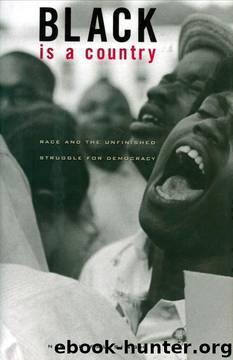
Author:Nikhil Pal Singh
Language: eng
Format: epub
Published: 2011-08-06T09:42:00+00:00
Reading An American Dilemma
By the mid1940s the identification of race with struggles for self-determination around the world posed a clear challenge to U.S. world hegemony. From the end of Reconstruction to World War II, dominant U.S. thinking regarded the "Negro problem" as a parochial, regional concern. During this period, however, black activists asserted with growing influence and cohesiveness that the color-line was an internal border within the country that also had global reach and significance. They not only struggled for full citizenship rights, but also claimed race as a site of communal investment and political action that exceeded U.S. political discourses and boundaries. Disciplining the latter tendency was part of the challenge of recoding the meaning of race in line with U.S. imperatives at the end of World War II. Most immediately, this meant severing black political and intellectual life from its engagements with parties of the left, or with anti-imperialist politics. It was imperative, Myrdal wrote, to demonstrate that "no social utopia can compete with the promises of the American Constitution and the American Creed it embodies. Democracy and lawful government mean so much more to a Negro, because he enjoys comparatively little of it in this country. Merely by giving him the solemn promise of liberty and equality, American society has tied the Negroes' faith to itself."''
Closer analysis of the production and interpretive procedures of the massive study sheds light on the racial commonsense of mid-century American liberalism and what might be termed its state's eye view of racial reform. The two published volumes bore the sole name of their Swedish author, even though black intellectuals (often laboring in segregated institutions) provided much of its substantive intellectual content and frequent reviews of the materials produced. Bunche, for example, penned four memoranda, comprising well over one thousand pages of prose, whose major findings were silently incorporated into the final report, while Frazier was entrusted with a final review of the manuscript. After World War II, when Myrdal returned to Sweden, an abridged version of the study was published under the name of another of Myrdal's assistants, the white academician Arnold Rose. Meanwhile, on the black "street" an argument raged as to whether Bunche was in fact the "real" author of the justly famous work."
The debate about authorship might be read as an allegory for an era in which black gains were frequently tied to a demand for faithful forbearance, quiet acquiescence, and even self-erasure. Indeed, though it recognized the ongoing differential treatment of blacks under the New Deal, An American Dilemma primarily testified to the powers of liberal-nationalism to recast black life in terms of the normalizing economic, juridical, and intellectual patterns of the nationstate as a whole. As Myrdal wrote with canny precision, "The Negroes' share may be meager in all this new state activity, but he has been given a share. He has been given a broader and more variegated front to defend and from which to push forward. This is the great import of the New Deal to the Negro.
Download
This site does not store any files on its server. We only index and link to content provided by other sites. Please contact the content providers to delete copyright contents if any and email us, we'll remove relevant links or contents immediately.
| Anthropology | Archaeology |
| Philosophy | Politics & Government |
| Social Sciences | Sociology |
| Women's Studies |
Cecilia; Or, Memoirs of an Heiress — Volume 1 by Fanny Burney(32562)
The Great Music City by Andrea Baker(32023)
Cecilia; Or, Memoirs of an Heiress — Volume 2 by Fanny Burney(31959)
Cecilia; Or, Memoirs of an Heiress — Volume 3 by Fanny Burney(31945)
We're Going to Need More Wine by Gabrielle Union(19053)
All the Missing Girls by Megan Miranda(16050)
Pimp by Iceberg Slim(14522)
For the Love of Europe by Rick Steves(14174)
Bombshells: Glamour Girls of a Lifetime by Sullivan Steve(14081)
Norse Mythology by Gaiman Neil(13376)
Talking to Strangers by Malcolm Gladwell(13376)
Fifty Shades Freed by E L James(13247)
Mindhunter: Inside the FBI's Elite Serial Crime Unit by John E. Douglas & Mark Olshaker(9347)
Crazy Rich Asians by Kevin Kwan(9297)
The Lost Art of Listening by Michael P. Nichols(7509)
Enlightenment Now: The Case for Reason, Science, Humanism, and Progress by Steven Pinker(7316)
The Four Agreements by Don Miguel Ruiz(6770)
Bad Blood by John Carreyrou(6626)
Weapons of Math Destruction by Cathy O'Neil(6284)
